| About this site | About the author | Urban rail in Finland | www.alkutieto.fi Company site of the author |
Back to Finnish main page  |
Public transport in Helsinki urban area | Report of the auditors in Helsinki at 1992 | TramWest Light Rail plan for Espoo. |
Topical issues
Turku
The city of Turku will decide in autumn for a return of the trams into the city. Read more!
Tampere
The city of Tampere started to build a tramway in 2017. It is the first new tram system in Finlad for 105 years after the opening of the Viipuri tram. Read more!
Raidejokeri – Joker-Tram
After 25 years of waiting Helsinki and Espoo finally decided to build an orbital Light Rail line. Construction started in 2019. The article of this site describes the long preparation of the tram line (in Finnish).
The cost of a place-kilometer calculated over the life cycle of the system indicates the cost of different transport modes in comparable way
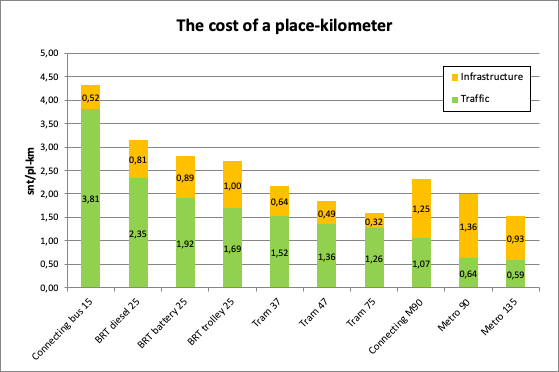
Buses are small and they have a short life time. But they are cheap to buy and they are used on streets that the operator do not need to finance. Trams and trains are large, they have long life time, high unit price and also tracks need to be invested. It is possible to compare the cost of transport modes, including motoring, calculating the unit cost over the life cycle and for an offered passenger place. Including also the cost of streets, tracks and other required infrastructure. Read the in-depth article about transport system cost!
Helsinki tram network finally expands to suburbs
In 1950's Helsinki planned to connect the growing suburbs to city centre with fast tram lines and tram tunnels in the city centre. 10 years later these plans were cancelled and tram system was condemned to be closed. Street space was needed for growing motoring. Only in 2010's suburban tram lines returned to the master plan and the building of the first orbital tram line started in 2019. Read about the history of the Helsinki public transport!
Prague is a lesson to learn what comes to offer public transport services as a passenger in the first place
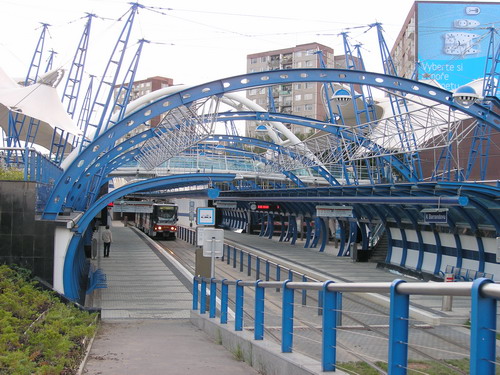
Prague had an excellent tram system, but Soviet standard in 1970's was a Moscow-like metro. Still the city relied on trams, which also today is one of the most clever urban rail system all over. Read about the key features of the public transport in Prague!
About this site
Dear reader,
I'm sorry to offer this site mostly in Finnish. But there are plenty of high quality English Light Rail, Tramway and Urban Rail sites in the Internet. And I believe, that nearly everything that I have included into this site can be found in some of the other sites. But what comes to some special details I believe are specific for Finland or in my work, I have translated them to English. Still, as the Finnish site is large, only a very small portion is available in English.
The structure of this English version is therefore not equal to the Finnish site. I have built the English site as an independent site, based on the items I have included. If you wish to browse the Finnish version, you may notice an English link where the content can be found in the English site.
Call to promote Light Rail
The reason why this site is mostly in Finnish is that modern public rail transport is not well known in Finland. At the moment there is only one city, the capital Helsinki, having rail bound public transport in operation in Finland. The development of the Helsinki tram network finished in 1950's when the idea of an underground public transport system was introduced. The planned extensions of the Helsinki tram network were cancelled, though the decision to build an underground was finally made only in 1969. Very few new tram tracks have been opened since, and the tram network has remained in traditional street track form without real priorities.
The lack of knowledge in Finland has been raised in view in Helsinki urban area, where Helsinki city opened a short metro line after 10 years of test run in 1982. The idea to build an underground was proposed in 1955 and the final decision to build a metro was made in 1969. During these years the Light Rail ideas originating to the beginning of the 1900's were changed to heavy rail. The growth of the Helsinki population ended in 1960's, and when the heavy metro was finally in service, it was too heavy for the size of the city. The population of the region had grown, but sprawled around the city of Helsinki as too low density to be possible to serve with public transport, especially with a heavy metro like the Helsinki metro is.
It was sad, that at the same time as the idea of the Stadtbahn was discovered in Germany, same ideas were put aside in Helsinki. And when the first Stadtbahn lines started to operate in Frankfurt, Germany, Helsinki decided to build a train like metro system and later started to run test drives with metro trains developed from the scratch in Finnish industry. And all this ended up into a situation, where Light Rail ideas were totally ejected and the tram network was planned to be closed in Helsinki too, as what happened in another Finnish city Turku in 1972.
The pressures to extend the short metro line grow during the 1980's. I was asked to establish a pressing group to promote less expensive and environmental friendly Light Rail solutions instead of extending the heavy metro. Very soon we noticed that no-one understood what we were talking about. Characteristic for the Finnish discussion was – and quite much still is – that ’rail traffic’ is understood as heavy rail only, meaning the heavy metro and commuter train services.
In 1980's it was a time without Internet, so the information our pressing group distributed the old fashion way was forgotten in the end of 1990's. In this situation the first Light Rail site was published in 1999. It included the information I made in the end of 1980's for the first time in paper form. This site is following that work but using the methods suitable for Internet. Our pressing group, Kansalasiliike pikaraitiotie (Citizen's movement Light Rail) built also a web site in 2006 named TramWest to promote alternative Light Rail plan for the metro plans in Espoo, western neighbour of Helsinki.
Hoping to see new era
In 2019, 20 years later, the situation is much more positive than at the time this site was created in 1999.
Though our pressing group failed in switching the metro extension in Espoo to a Light Rail project and the Espoo metro has finally started to operate after years of dealys and at least tripleing it's budget, new Light Rail plans are also proceeding. And not only in Helsinki area.
In Helsinki area there were strong forces trying to extend the metro not only to west in Espoo but also to east to Östersundom. Even though the studies proved, that the metro will increase the car use and cost of public transport. After the experience of planning and building the Espoo metro, authorities started to consider the price tag of at least 700 million Euros in east for a 8 kms tunnel line to the un-built forests to be too much. At the same time the city planners interest for a new suburb far from the city has melted. Helsinki is now focusing to expand the dense city centre area and convert the motorways in the city to boulevards with tram lines.
While pressing group failed with Light Rail in Espoo, the builders of the metro failed too. Currently the western metro is a landmark and synonyme for a huge civil engineering project that includes all possible mistakes. It is sad for the reputation of urban rail, but luckily there have been other successful projects to prove, that the mistake is not urban rail itself. There are proper methods to realize a large project successfully. Though the leading newspaper calculated that the real price tag has risen over 2,000 million Euros for only 14 kms underground line. And same is going to happen with on going metro extension up to Kivenlahti.
But there are positive signs. The former harbor areas in the city centre are on a way to become converted to housing to expand the city centre area. These new development areas Jätkäsaari in west and Kalasatama, Sompasaari and Hermanninranta in east will be served with trams, though in old street tram form with track geometry not suitable for fluent traffic. For these extensions a 70 unit patch of new trams has been ordered and delivered to the autumn 2019. The conversion of the orbital bus line 550 (’Jokeri’) to Jokeri Light Rail has started. After the decision of the Finnish state to give a support for the project in condition to start the project immediately. The former oil harbor area in Laajasalo isle at the east side of Helsinki will also be developed for housing and an important part of the plan is a direct tram connection over the sea to the city.
Finland will also have a new tram city at 2020’s. City of Tampere, 170 kms north from Helsinki, is building a totally new tram system as a part of the regional land use plan. The city council of Tampere decided in November 2016 to forward to building of a 24 kms line. There are also preliminary plans to return trams to Turku. In autumn 2019 city council is going to choose either continuing with ordinary buses, build a BRT or a Light Rail.
Still the biggest problem in Finland is the general attitude towards car dependent urban structure. Parking norm guarantees space for cars to everybody and shopping malls dominate. Services in walking distance are exception. Traffic system is dimensioned for full car based mobility and public transport investments are never an alternative to road building. Multi level crossings and motorways are always absolutely necessary and there is no question about the price. Even the smallest section of track or bus lane must be proved to be profitable, but still it may be delayed for years. Expensive underground solutions are preferred as they free street space for cars – as was the argument for the metro in 1955, the year of my birth.
Back to top of the page.
About the author

My name is Antero Alku, and I am a master of sciences in engineering. I finished my studies in 1980 in Tampere University of Technology. I started my career in automotive industry but later I worked near 20 years in computer business.
As written in ’About this site’, I was asked to establish a pressing group to promote Light Rail already in the end of 1980's. I was also asked to join politics in early 1990's, but I did not. In the beginning of 2000's I started to think politics again. I joined to city council election in 2004 and I was a vice member in the Helsinki city planning committee 2005–2008. In practice I was a member, as we shared the meetings with my counterpart depending on available time and items to discuss. It was very interesting work and it made me feel that the decision to join politics was the right choice.
I have written two books about public rail transport. The first one was published in 2002 with the name Raitiovaunu tulee taas (Tram is coming again). The Finnish title can be understood two ways. Either it means that a tram is approaching the stop, but it can also be understood that trams are returning as a means of public transport. This book is sold out.
My second book was released in June 2007 with name Mennäänkö metrolla? – Joukkoliikenteen uusi aika. (Let's take Light Rail – The new Era of Public Transport). The Finnish name includes a word ’metro’ in the place of ’Light Rail’. That is because there is no proper translation for the German word ’Stadtbahn’ which for the most means what is modern integrated rail bound public transport. When a Finn travels in one of the worlds Light Rail or Stadtbahn systems, he says that he sits in a metro. Because often they are larger than Helsinki trams and operates faster compared to Helsinki, where trams often stand in traffic jams. The Helsinki metro is not a commuter train, but it is faster and larger than trams in Helsinki and its track is underground in the city centre and on ground in suburbs. Helsinki metro is just like the Stadtbahn, only street sections are missing. For you who are more familiar with rail traffic, I can compare Helsinki metro for the most to the Berlin or other German S-Bahn systems.
In the beginning of the new millennium I decided to switch from computer business to transport. I started my own engineering agency, which is specialized to public transport and rail transport. I continued my studies from 2005 on. I studied in Aalto University's School of Engineering (former Helsinki University of Technology) for a doctorate. But I also need to work which I do as a consultant in my one man company Alkutieto Ltd. My studies included traffic planning and urban planning and design. The subject of the dissertation study plan is ”Determining the suitability of public transport.”
In my company I have made studies for commuter train and urban rail traffic planning and researched urban rail transport and worked in procurement of urban rail systems. From 2009 I worked to Helsinki City Transport within the purchase process of the new trams. The first phase was to specify the new tram, organize the tendering and choose the manufacturer. After the Helsinki project I started to work for the city of Tampere as a tram expert to specify the tram system to be planned and built. Then I guided the procurement process for both infrastructure and rolling stock the similar way as in Helsinki. Finals step was the signing of the tram contract in October 2017. Since that I have worked mostly for the City of Helsinki in various urban rail projects.
In my age I have started to look for retirement. But I have a couple of years still to work, so I have a chance to participate the unexpected development of urban rail systems in Finland.
This site is created by Antero Alku, M.Sc. (eng).
Back to top of the page.
Feedback and queries, please use e-mail to address:

Made by Antero Alku, 25.3.2003 | Latest update 23.7.2019 / AA
Mennäänkö metrolla? Sorry, in Finnish only!
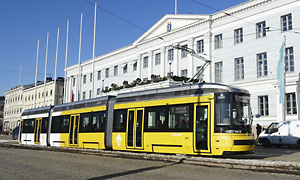
Top: The second series new low floor Artic-trams in Helsinki front of city hall but in Turku livery for promotional purposes. Artic tram is a concept designed jointly with Helsinki City Transport Authority and Transtech, a Finnish rail rolling stock manufacturer. February 2018.
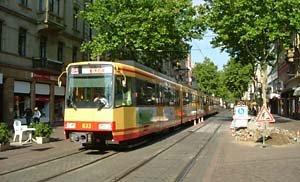
Mid: A train of 2 double voltage trams at Kaiserstrasse pedestrian area in Karlsruhe, Germany, July 2003.
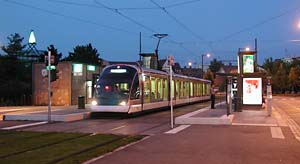
Bottom: Eurotram in Strasbourg just after the sunset in July 2003.
All photos by Antero Alku.